Projects / 2023-2026
NETCAT Group software workflows
Development of software tools for the NETCAT Group: STM/EC-STM analysis, object detection and tracking, lattice metrology, expert-assisted deep learning and human-in-the-loop workflows from raw images to quantitatively validated results.
Context
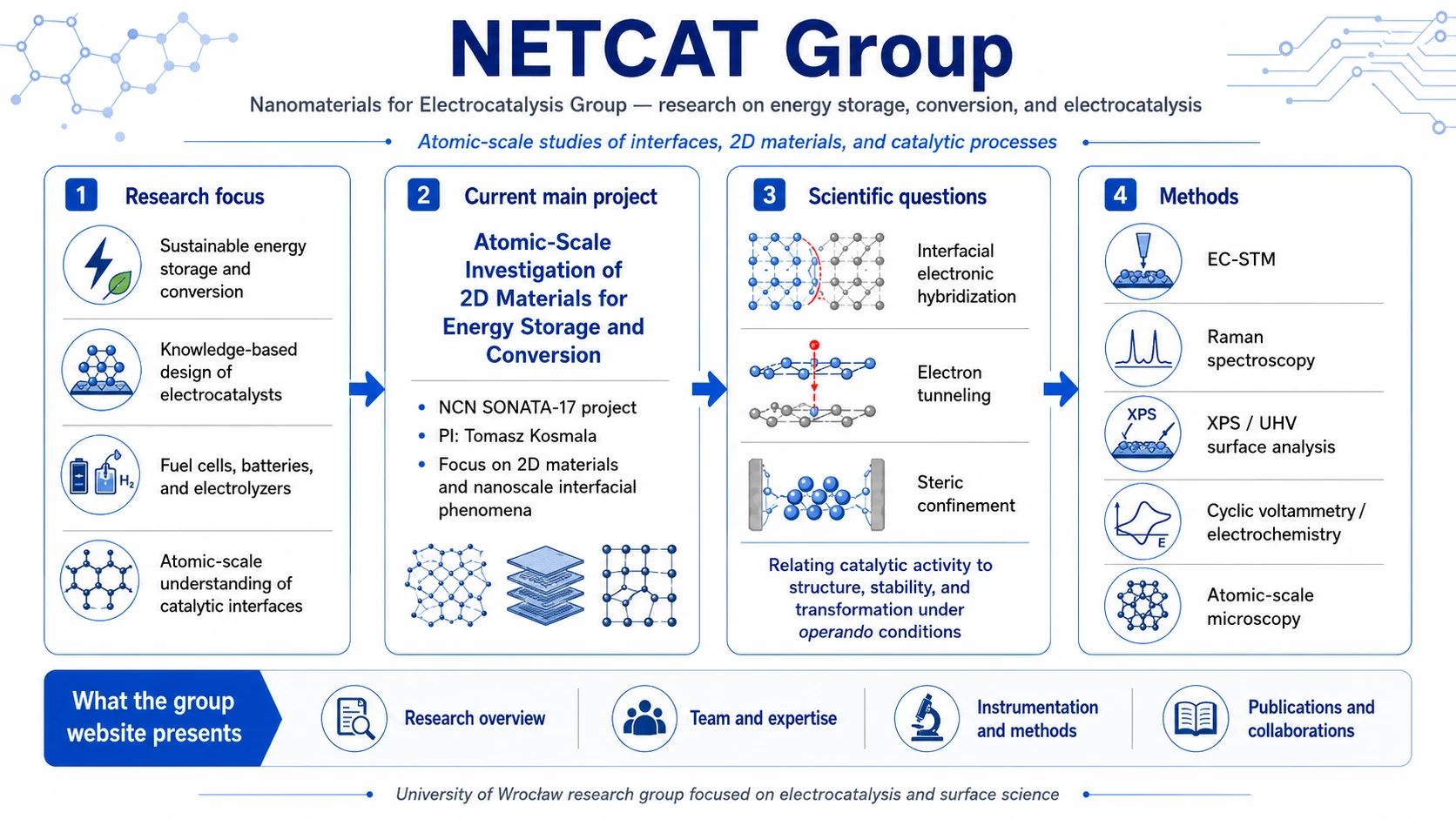
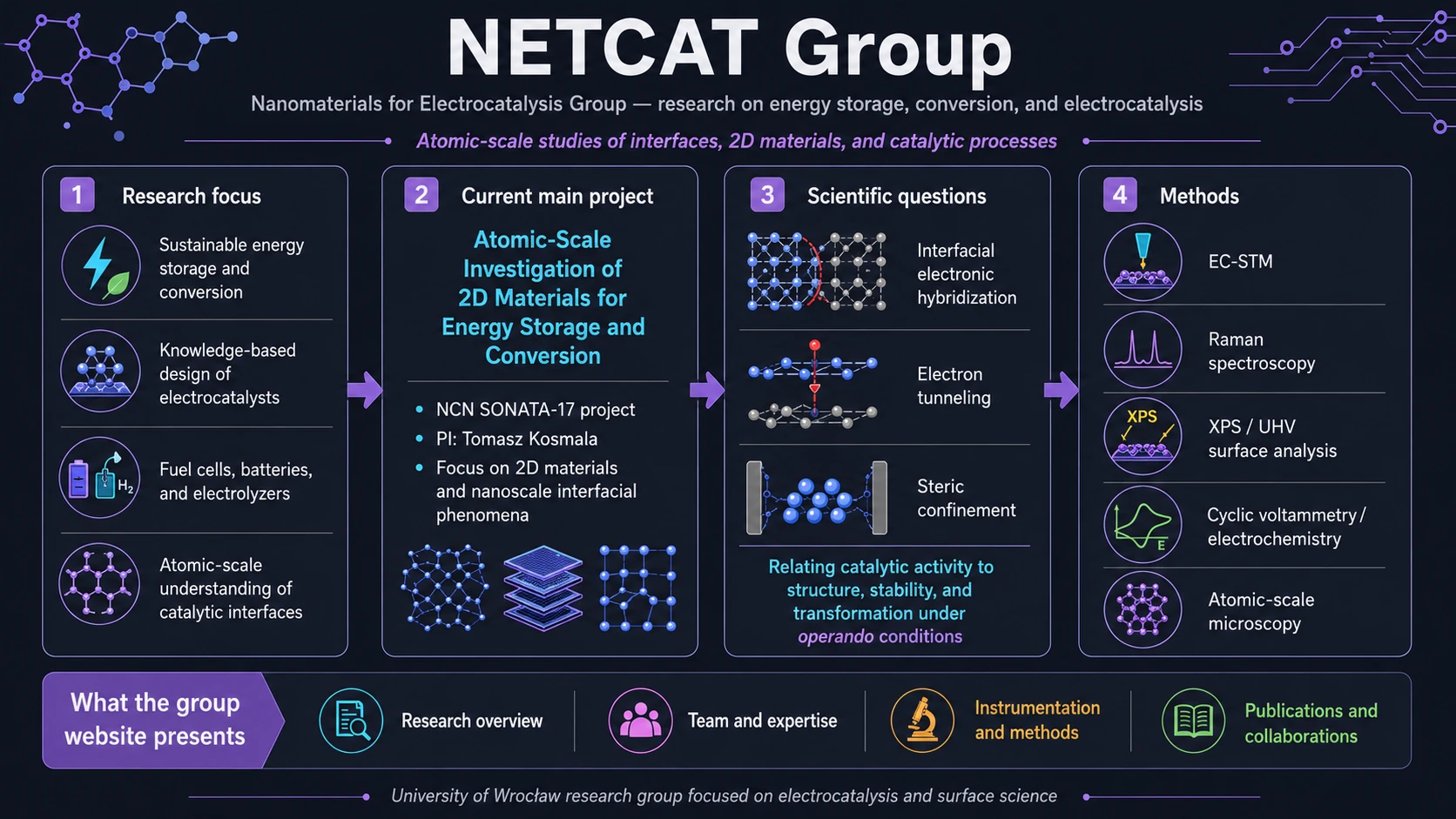
NETCAT Group — Nanomaterials for Electrocatalysis Group — is my main research context for work related to STM, EC-STM and related surface-imaging data. Within this area I develop software tools that connect experiment, image analysis, machine learning and quantitative validation.
My role focuses on building practical workflows for difficult experimental data: noisy microscopy images, operando sequences, multi-channel data and measurements that require manual quality control. The goal is to move from raw images to reproducible, documented and quantitatively comparable results.
Research Context
The NETCAT Group works on nanomaterials for electrocatalysis, with emphasis on energy storage and conversion, catalytic interfaces, 2D materials and processes at solid-liquid interfaces.
In practice this means working with images and sequences where both atomic-scale details and changes over time, electrochemical potential or imaging conditions matter. Typical data issues include drift, scanner distortions, unstable contrast, local defects, differences between topography and current channels, and the need to compare results across multiple frames or experiments.
My Contribution
My contribution is the development of tools that support surface-data analysis from the software-engineering and metrology side:
- designing desktop applications in Python and PyQt6,
- building human-in-the-loop workflows for data curation and quality control,
- integrating classical image-processing algorithms with deep-learning methods,
- developing tools for detection, segmentation, tracking and image registration,
- preparing data exports, session formats, tables and results for downstream analysis,
- organizing code, documentation and technical descriptions so that the tools can be used reproducibly.
Related Software Tools
LFA — Lattice Fourier Analyzer
LFA is a published tool for quantitative STM/EC-STM analysis in Fourier space. It supports Bragg-peak localization, drift and scanner-distortion correction, lattice-parameter estimation and substrate-adsorbate registry analysis.
MolDetA v2
MolDetA v2 is used for curation and analysis of molecular objects in multi-scan STM data. It combines image registration, geometry propagation, detection, manual bbox editing, object grouping and downstream analysis.
NaParA — Nanoparticle Analyzer
NaParA supports nanoparticle analysis in STM images: preprocessing, ROI selection, contour detection, metric computation and result export. The tool is developed for fast and repeatable quantification of objects on surfaces.
NanoTrack
NanoTrack is designed for STM sequences. It supports frame registration, seed creation, object tracking and step-edge analysis. Different tracking and segmentation backends are tested within this workflow.
Deep Learning And Human-In-The-Loop Workflows
In these tools, deep learning is treated as an expert-support layer, not as the only source of truth. Models are used for detection, segmentation, seed generation, tracking and comparison with classical image-processing pipelines.
This workflow is especially important for STM/EC-STM data, where contrast can depend on tunneling conditions, electrochemical potential, imaging channel and local surface structure. The user must be able to inspect, correct and validate each important analysis step.
Technical Stack
| Area | Technologies and libraries |
|---|---|
| Desktop GUI | Python, PyQt6, pyqtgraph |
| Numerical analysis | NumPy, SciPy |
| Image processing | scikit-image, OpenCV, morphological filters, registration, optical flow |
| Deep learning | PyTorch, YOLO, U-Net, SAM-family, tracking backends |
| Visualization | matplotlib, pyqtgraph, image overlays, result tables |
| Data | STM/EC-STM/LEED formats, CSV, JSON, STP, session files |
| Validation | unit tests, regression tests, comparison with manual references, quality metrics |
| Documentation | README files, user guides, workflow descriptions, technical documentation |
Example Applications
Substrate-adsorbate registry analysis in EC-STM
LFA enables quantitative analysis of systems where the substrate and adsorbate are observed under different contrast conditions. The workflow anchors metrology in a known substrate lattice and transfers the correction to the adsorbate image.
Molecular-object curation across multiple STM channels
MolDetA v2 supports work with multiple scans of the same area, allowing users to detect, propagate, manually correct and group objects into consistent sets.
Quantitative nanoparticle analysis
NaParA supports object detection and measurement on surfaces: area, centroid, object count, size distribution and nearest-neighbor distances.
Dynamics tracking in STM sequences
NanoTrack combines frame registration, seed detection, tracking and metric analysis for sequences where objects or step edges change position or shape over time.
Project Status
This is an actively developed area of work. Some tools are already used in real analyses, while others are being tested or refactored. The shared goal is to build a stable software ecosystem for quantitative analysis of STM, EC-STM and related surface-imaging data.